Moving prepared food between a commercial kitchen, catering venue, school, or event requires more than a sturdy container. The right insulated carrier helps preserve serving temperatures, protect pans, and simplify loading and unloading.
We selected 10 front-loading insulated food carriers across several capacities, materials, layouts, and mobility options so you can match the carrier to your menu, workflow, and transport demands.
Best 10 Front Loading Insulated Food Carriers Picks for 2026
Best High-Capacity Value
VEVOR 95 Qt Front-Loading Carrier
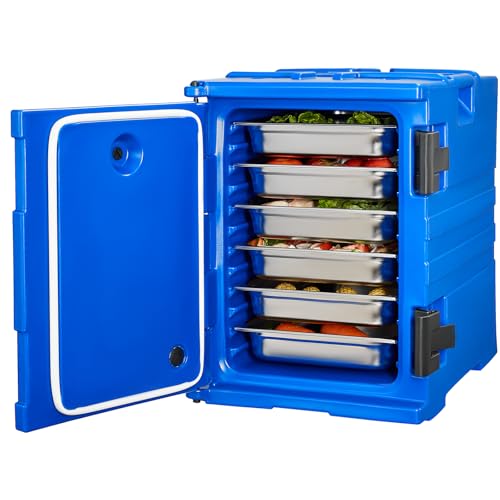
- Non-electric insulation holds hot food 4–6 hours.
- Accommodates up to six 2.5-inch pans.
- Wheels, handles, and stacking grooves aid transport.
Best For: High-volume catering and event service
Best Commercial-Grade Build

- 304 stainless steel latch and door shaft improve durability.
- Non-electric insulation maintains temperatures for 4–6 hours.
- Fits six full-size 2.5-inch pans.
Best For: Commercial kitchens and frequent catering use
Best Established Five-Pan Design

- Maintains hot or cold food for up to six hours.
- Holds five full-size or ten half-size pans.
- Rugged body includes front and rear molded handles.
Best For: Catering teams needing a five-pan carrier
Best for Flexible Wheeled Transport

- 12 slots support multiple pan heights and configurations.
- Removable casters include swivel and braking wheels.
- Includes one stainless steel pan and a 270-degree door.
Best For: Mobile catering and one-person transport
Commercial Capacity Pick

- Holds up to five full-size food pans
- Retains temperatures for up to four hours
- Stackable NSF-listed polyethylene design
Best For: Commercial catering and food-service transport
Extra-Large Wheeled Option

- Offers 118-quart capacity
- Keeps food hot or cold without power
- Includes wheels and durable LLDPE construction
Best For: High-volume catering and mobile events
Lightweight Professional Pick

- 45-quart capacity for four pans
- Retains temperatures for up to five hours
- Lightweight, stackable EPP construction
Best For: Professional catering with frequent carrying
Best Lightweight Commercial Pick

- Holds up to six full-size pans
- Lightweight, impact-resistant EPP construction
- Front-loading access for faster service
Best For: Catering teams and commercial kitchens needing a portable six-pan carrier
Best Mobile Value

- 81-quart capacity with multiple pan configurations
- Keeps food warm 4–6 hours or chilled 3–5 hours
- Wheels, handles, buckles, and stackable design
Best For: Catering and delivery operations needing capacity plus mobility
Best Long-Hold Capacity

- 95-quart capacity for up to five full-size pans
- Stated 6–8-hour hot and 5–7-hour cold retention
- Wheels and 270-degree opening simplify unloading
Best For: High-volume operations needing extended non-electric temperature retention
Best High-Capacity Value – VEVOR 95 Qt Front-Loading Carrier
For buyers comparing front loading insulated food carriers, the VEVOR 95-quart model stands out for high-volume transport without electricity. Its insulated LLDPE and polyurethane construction is designed to hold hot food for 4–6 hours or chilled items for 3–5 hours.
Best For: Catering teams, dining halls, hotels, and outdoor events that need large capacity, stacking, and wheeled transport.
Pros:
- Holds up to six 2.5-inch pans or three 6.5-inch pans.
- Top handles and bottom wheels make a full carrier easier to move.
- 270-degree door opening and 11 interior layers simplify loading and access.
- Grooved top supports stable stacking.
Cons:
- Food pans are not included.
- At 36.4 pounds, the carrier is substantial even before loading.
- Hand washing is recommended.
Choose this VEVOR carrier when capacity and transport features matter most. Its vented design, menu slot, latches, and stacking grooves make it a practical workhorse for repeated catering or delivery use.
Best Commercial-Grade Build – CAMMOO NSF 95 Qt Food Warmer
The CAMMOO 95-quart carrier is a strong option among front loading insulated food carriers for commercial kitchens. It combines a food-safe LLDPE body with 304 stainless steel hardware and electricity-free insulation rated for 4–6 hours.
Best For: Restaurants, schools, caterers, food trucks, and other operations that prioritize durable hardware and commercial food-safety features.
Pros:
- NSF-certified model designation is intended for commercial food-service use.
- 304 stainless steel shaft and latch resist rust and repeated-use damage.
- Fits up to six 2.5-inch full-size pans.
- Four wheels, top handles, and a 270-degree door support easier handling.
Cons:
- Pans are not included.
- Hot and cold food should not be stored together.
- The product listing notes a maximum temperature of 170°F.
CAMMOO is the better fit when hardware longevity and commercial-grade positioning are priorities. Its stain- and odor-resistant surface also helps simplify cleanup after busy service periods.
Best Established Five-Pan Design – Carlisle Cateraide Carrier
The Carlisle Cateraide offers a straightforward front-loading format for buyers who need dependable catering transport without an oversized six-pan layout. Its commercial-grade insulation is designed to maintain hot or cold food for up to six hours.
Best For: Catering, restaurant, and kitchen teams transporting five full-size pans or smaller half-size portions.
Pros:
- Holds five full-size pans or ten half-size pans.
- Rugged plastic construction is built for transport and high-heat exposure.
- Molded front and back handles provide multiple carrying options.
- Snap-lock clasps and a gasket help seal in temperature.
Cons:
- It does not list wheels for rolling transport.
- Hand cleaning with a damp cloth is recommended.
- Its 38.6-pound weight may make loaded carrying demanding.
This Carlisle model is a practical choice for operations that prefer a proven five-pan capacity and simple carry handles. It is less convenient than wheeled alternatives for long-distance movement, but its snap clasps and rugged construction support routine service work.
Best for Flexible Wheeled Transport – YITAHOME 95 Qt Carrier
For front loading insulated food carriers with flexible mobility, the YITAHOME 95-quart model adds removable swivel casters and braking wheels to a double-wall LLDPE body. Its polyurethane foam insulation is designed to retain temperatures for 4–6 hours.
Best For: Restaurants, gatherings, outdoor events, and catering jobs where one-person movement and adaptable pan storage are especially useful.
Pros:
- 12 interior slots accommodate six 2.5-inch, four 4-inch, or three 6-inch pans.
- Four removable wheels include directional, swivel, and braking functions.
- 270-degree door opening provides convenient access.
- Includes one stainless steel pan.
Cons:
- Simultaneous hot and cold food storage is not recommended.
- At 41.2 pounds, it is the heaviest listed carrier.
- The product details identify an 82-quart capacity despite the 95-quart title.
YITAHOME is compelling when rolling flexibility and varied pan heights are more important than minimal weight. The removable casters, brake function, menu slot, and stain-resistant body make it well suited to active service environments.
Commercial Capacity Pick – 5-Pan Front-Loading Carrier
This front-loading insulated food carrier is designed for commercial food transport, holding up to five full-size pans while retaining temperatures for up to four hours. Its polyethylene construction, stackable shape, built-in handles, and NSF listing make it a practical choice for catering and food-service operations.
Best For: Caterers and food-service teams transporting up to five full-size pans.
Pros:
- Holds up to five full-size food pans.
- Retains food temperature for up to four hours without power.
- Stackable, NSF listed, and built with integrated handles.
- Heavy-duty polyethylene construction supports commercial use.
Cons:
- At 32 pounds, it is heavier than lightweight carrier options.
- Its 25-inch height and large footprint require dedicated storage space.
- Uses passive cooling and does not provide powered heating or cooling.
This is a strong fit when pan capacity, stackability, and food-safety compliance matter more than minimizing weight. The four-hour retention period suits routine catering runs and service staging.
Extra-Large Wheeled Option – 118QT Front-Loading Carrier
This front-loading insulated food carrier offers a very large 118-quart capacity for multiple trays or bulk meal portions. Its non-electric insulation is intended to keep food cold or warm, while the durable LLDPE construction and wheels support mobile catering, banquets, and extended deliveries.
Best For: High-volume catering teams that need substantial capacity and easier movement between locations.
Pros:
- Provides a spacious 118-quart capacity for trays or bulk portions.
- Maintains hot or cold food without electricity.
- Front-loading access helps staff load and serve pans efficiently.
- Durable LLDPE construction and wheels improve portability.
Cons:
- Its listed shipping weight is 52.4 pounds, making it a heavy option.
- The product details list unusually narrow dimensions, so buyers should verify measurements before ordering.
- No specific temperature-retention duration is provided.
This carrier emphasizes volume and mobility rather than compact storage. Confirm the physical dimensions and available route space before choosing it for large-scale food transport.
Lightweight Professional Pick – METRO Mightylite ML300
The METRO Mightylite ML300 is a lightweight front-loading insulated food carrier with a 45-quart, four-pan capacity. Its expanded polypropylene construction, eight integrated handles, stackable design, and reported five-hour temperature retention make it well suited to catering teams that frequently carry and organize multiple carriers.
Best For: Professional caterers who prioritize low weight, five-hour retention, and stackable transport.
Pros:
- Holds up to four pans or 45 quarts.
- Retains hot or cold food temperatures for up to five hours.
- Lightweight EPP construction weighs about 9.1 pounds for the ML300.
- Includes integrated handles, a swing door, wire caddy, and secure stacking compatibility.
Cons:
- The carrier is hand-wash only.
- Optional dolly, partition, heater, and carrying strap accessories are sold separately.
- Its capacity is lower than the larger five-pan and 118-quart alternatives.
This is the most weight-conscious option of the group while still offering professional features and a five-hour retention claim. It is especially appealing for frequent loading, unloading, and multi-carrier transport.
Best Lightweight Commercial Pick – 6-Pan EPP Front Loader
For teams comparing front loading insulated food carriers, this EPP model offers a straightforward balance of capacity, portability, and quick access. It holds up to six full-size pans and is designed for restaurants, catering operations, cafeterias, food trucks, and institutional kitchens.
Best For: Catering teams and commercial kitchens that need a lightweight carrier for organized food transport.
Pros:
- Holds up to six full-size food pans.
- Front-loading access helps staff load and remove pans efficiently.
- Expanded polypropylene construction is lightweight, impact-resistant, and suited to daily food-service use.
Cons:
- The supplied details do not specify a claimed hold-time range.
- Food pans are not listed as included.
This is a practical choice when easy front access and lower carry weight matter more than built-in mobility features. Its commercial focus makes it well suited to transporting prepared meals, buffet dishes, and catering items between service areas.
Best Mobile Value – VEVOR 81-Qt Front Loader
This VEVOR model is one of the more versatile front loading insulated food carriers for larger food runs. Its 81-quart capacity accommodates several pan configurations, while the insulation is designed to keep food warm for 4–6 hours or chilled for 3–5 hours without electricity.
Best For: Restaurants, caterers, and delivery operations that want a sizable carrier with wheels and stackable storage.
Pros:
- Supports five 2.5-inch pans, three 4-inch pans, or two 6-inch pans.
- Double buckles help secure the door and support a tight seal.
- Fixed casters, external handles, and a stackable top groove improve transport and storage.
- Non-electric insulation supports hot or chilled food transport.
Cons:
- At 33.4 pounds, it is relatively substantial to move when loaded.
- Food pans are not included.
- The listed fixed casters may be less flexible than swiveling wheels.
Choose this carrier if mobility and flexible loading options are priorities. It is especially useful for operations moving food between vehicles, kitchens, events, and service locations while conserving storage space through stacking.
Best Long-Hold Capacity – ICECON 95-Qt Wheeled Carrier
For high-volume service, this ICECON carrier combines a 95-quart interior with a thick insulated LLDPE and PU-foam construction. Among these front loading insulated food carriers, it stands out for its stated 6–8-hour hot and 5–7-hour cold retention, along with wheels and a door that opens up to 270 degrees for unloading.
Best For: Restaurants, hotels, canteens, and event operators transporting multiple hot or cold dishes over extended service periods.
Pros:
- 95-quart capacity holds up to five full-size food pans.
- Claims 6–8 hours of hot retention and 5–7 hours of refrigeration without electricity.
- Rotomolded construction, an average 2.1-inch wall thickness, and reinforced fasteners support durability and insulation.
- Four wheels, side handles, stackable design, and a 270-degree door opening aid handling and unloading.
Cons:
- At 41 pounds, it is the heaviest option in this selection.
- Food pans are not included.
- The large footprint may require more storage space.
This is the strongest fit when extended temperature retention and high-volume capacity are more important than minimizing weight. The wheeled base and wide-opening door help offset its heavier construction during busy catering or institutional service.
How We Picked the Best Front Loading Insulated Food Carriers
We compared these carriers by the factors that matter most in real catering and food-service use: usable pan capacity, insulation design, construction, loading access, portability, cleaning requirements, and temperature-retention claims. We also considered practical details such as door hardware, handles, wheels, latches, stackability, and compatibility with full-size food pans.
Capacity descriptions can vary by manufacturer, so confirm the exact pan dimensions and included accessories before ordering. Several models list pans, racks, or accessories separately rather than including them.
Quick Comparison
- Best for high-volume catering: 95- to 118-quart LLDPE carriers with room for multiple full-size pans.
- Best for frequent transport: Models with swivel casters, fixed wheels, or reinforced handles.
- Best for lighter-duty mobility: EPP carriers, which are generally easier to lift than molded polyethylene units.
- Best for professional durability: Commercial-grade carriers with robust latches, thick walls, and NSF-related specifications.
- Best for smaller loads: Five-pan or compact carriers that take up less storage space.
Key Buying Factors for Front-Loading Insulated Food Carriers
Capacity and Pan Compatibility
Start with the number and type of pans you transport most often. A carrier designed for six full-size pans may be excessive for small deliveries but valuable for buffets and large events. Check whether it accepts hotel pans at your preferred depth, especially if you use deep pans for soups, stews, or braised dishes.
Insulation and Temperature Retention
These carriers are designed to hold hot or cold food without powered heating or cooling. Retention time depends on starting temperature, food density, opening frequency, ambient conditions, and how full the carrier is. Treat stated retention periods as testing references rather than guarantees for every route.
Construction and Cleaning
LLDPE molded carriers are durable and suited to demanding commercial use, while EPP models can reduce weight and simplify handling. Look for smooth, nonporous interiors, removable components where available, secure door seals, and surfaces that can be washed and sanitized efficiently.
Mobility and Storage
Wheels and swivel casters help when moving heavy loads across kitchens, loading docks, and venues. Handles matter when lifting or maneuvering, but a fully loaded carrier can be extremely heavy. Measure doorways, vehicle compartments, storage areas, and elevator access before buying. Stackable designs can save space when several units are in rotation.
Latches, Doors, and Food-Service Standards
Front-loading doors make it easier to access pans without unloading the entire carrier. Stainless-steel latches, double-buckle closures, and sturdy hinges can improve long-term reliability. If the carrier is for regulated food-service operations, review its NSF listing or other stated compliance information and follow local food-safety procedures.
Who Should Buy Which Front Loading Insulated Food Carriers?
Choose a large 95- or 118-quart carrier if you regularly transport several full-size pans for catering, banquets, or institutional service. A five-pan unit is a better fit for smaller operations that value a reduced footprint. Select a wheeled model for frequent long-distance movement, and consider a lightweight EPP carrier when staff often lift the unit into vehicles. For demanding daily use, prioritize durable molded construction, dependable latches, easy-clean interiors, and verified pan compatibility over cosmetic features.