The best energy-efficient mini refrigerators keep drinks, snacks, and everyday essentials cold without taking up much space or adding unnecessary operating costs. This roundup compares 10 compact models with useful features such as adjustable thermostats, reversible doors, freezer compartments, and low-noise operation.
Whether you need a dorm refrigerator, bedroom cooler, office unit, or compact backup fridge, the right choice depends on capacity, temperature control, layout, and verified efficiency—not just the lowest upfront price.
Best 10 Energy Efficient Mini Refrigerators Picks for 2026
Best Ultra-Compact Pick
Midea 1.6 Cu. Ft. Energy Star Mini Fridge

- Compact 1.6-cu.-ft. footprint
- Energy Star certified; 207 kWh/year listed
- Quiet, reversible, and adjustable
Best For: Tight spaces and personal beverage or food storage
Best Overall Storage Balance
Upstreman 3.2 Cu. Ft. Mini Fridge

- 3.2 cu. ft. total capacity with freezer
- Energy Star certified; 206 kWh/year listed
- 38 dB operation and flexible shelving
Best For: Dorms, offices, and bedrooms needing more storage
Best Style-Focused Choice
ICEBOX 2.5 Cu. Ft. Mint Green Mini Fridge

- 2.5 cu. ft. compact food and drink storage
- ENERGY STAR certified with R600a refrigerant
- Mint finish, reversible door, and removable shelves
Best For: Stylish dorms, offices, apartments, and home bars
Best Freezer Capability
3.2 Cu. Ft. Energy-Efficient Mini Fridge

- 3.2 cu. ft. capacity with dedicated freezer
- Listed use of 0.6 kWh per day
- Reversible door and adjustable storage
Best For: Compact frozen storage in bedrooms, offices, and dorms
Best Compact Energy Saver

- ENERGY STAR certified
- Compact freezerless design
- Reversible door and removable shelf
Best For: Dorms, offices, bedrooms, and apartments
Best Space-Boosting Value
3.2 Cu. Ft. ARCTIC CHEF Mini Fridge

- Includes a compact freezer compartment
- Adjustable thermostat and compressor cooling
- Reversible door with multiple storage shelves
Best For: Dorms, offices, apartments, and beverage storage
Best Efficient Fridge-Freezer Combo

- ENERGY STAR certified at 270 kWh annually
- 0.92-cu.-ft. top freezer
- Removable glass shelves and reversible door
Best For: Small spaces needing both fresh and frozen storage
Best Compact Pick
EUHOMY 1.7 Cu. Ft. Mini Fridge

- 0.55 kWh per day stated consumption
- Below-38 dB compressor operation
- Reversible door and removable shelf
Best For: Small rooms, countertops, and under-desk use
Best Larger-Capacity Value
3.2 Cu. Ft. Mini Fridge with Freezer

- 3.2 cu. ft. total capacity
- 0.55 kWh per day stated usage
- Top freezer and adjustable organization
Best For: Dorms, offices, and small kitchens needing freezer space
Best Simple Freezer Option
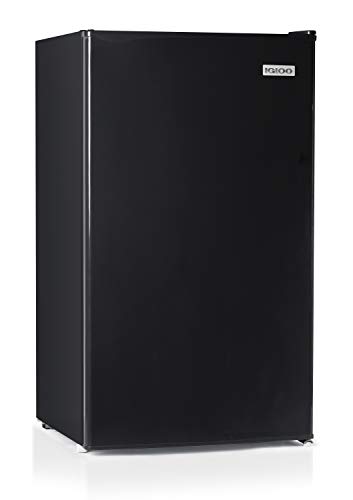
- 3.2 cu. ft. capacity with separate freezer
- Adjustable 32°F-to-50°F cooling range
- Automatic defrost and glass shelves
Best For: Straightforward home, dorm, and office food storage
Best Ultra-Compact Pick – Midea 1.6 Cu. Ft. Energy Star Mini Fridge
The Midea WHS-65LB1 is a practical choice when you need one of the most compact energy efficient mini refrigerators for a bedroom, dorm, apartment, garage, or office. Its 1.6-cubic-foot capacity, Energy Star certification, and listed annual consumption of 207 kWh balance low space requirements with everyday food and beverage storage.
Best For: Small rooms and users who prioritize a compact footprint, quiet operation, and basic refrigerated storage.
Pros:
- Compact 1.6-cubic-foot design fits tight spaces.
- Energy Star certified with listed consumption of 207 kWh per year.
- Reversible door, removable glass shelf, and 2-liter bottle rack improve placement and storage flexibility.
- Operating noise is listed below 42 dB.
Cons:
- Smaller capacity than the other full-height models in this roundup.
- Manual defrost requires periodic maintenance.
Choose this Midea if floor space is your main constraint. The adjustable thermostat, internal chiller box, and quiet compressor make it well suited to personal-use refrigeration, though its limited capacity is better for essentials than larger grocery loads.
Best Overall Storage Balance – Upstreman 3.2 Cu. Ft. Mini Fridge
The Upstreman BR321 combines a 3.2-cubic-foot interior with a small 0.3-cubic-foot freezer compartment, making it a versatile option among energy efficient mini refrigerators. It is Energy Star certified, lists 206 kWh of annual energy consumption, and operates at a stated 38 dB for dorms, bedrooms, and offices.
Best For: Users who want a taller mini fridge with flexible fresh-food storage and a small freezer section.
Pros:
- Provides 2.9 cubic feet of refrigerator space plus a 0.3-cubic-foot freezer compartment.
- Energy Star certified with listed annual consumption of 206 kWh.
- Two adjustable glass shelves, a crisper drawer, and door storage support organization.
- 38 dB operation and a reversible door suit bedrooms, dorms, and offices.
Cons:
- The freezer is not suitable for storing ice cream or ice cubes, according to the supplied notes.
- Manual defrost requires occasional maintenance.
With nearly twice the total capacity of the smallest pick while using a similar listed amount of annual energy, the BR321 is a strong all-purpose option. Its compact freezer is useful for short-term frozen storage, but shoppers needing a full-size freezer should look elsewhere.
Best Style-Focused Choice – ICEBOX 2.5 Cu. Ft. Mint Green Mini Fridge
The ICEBOX IBCR25MNT adds a distinctive mint-green finish to the energy efficient mini refrigerators category without giving up everyday practicality. Its 2.5-cubic-foot interior, chiller compartment, ENERGY STAR certification, and listed annual consumption of 212 kWh make it suitable for supplemental food and beverage storage.
Best For: Dorm rooms, home offices, apartments, and home bars where appearance and compact storage both matter.
Pros:
- ENERGY STAR certified and uses R600a refrigerant with a high-efficiency compressor.
- 2.5-cubic-foot capacity provides room for leftovers, drinks, and food.
- Removable glass shelves and a full-width door shelf support flexible organization.
- Reversible door and adjustable legs make placement easier.
Cons:
- Its listed annual consumption of 212 kWh is slightly higher than some larger models here.
- Manual defrost requires periodic upkeep.
The ICEBOX is a good fit when a mini fridge needs to complement a room rather than simply disappear into it. Its chiller compartment and removable shelving cover everyday needs, while the mint-green finish and other available colors provide more visual personality than a standard black unit.
Best Freezer Capability – 3.2 Cu. Ft. Energy-Efficient Mini Fridge
This 3.2-cubic-foot upright model is one of the more freezer-capable energy efficient mini refrigerators in the group. It includes a dedicated 0.35-cubic-foot freezer, lists average use of 0.6 kWh per day and 210 kWh annually, and offers adjustable storage for bedrooms, offices, and dorm rooms.
Best For: Shoppers who want a compact refrigerator with a dedicated freezer for ice cubes and short-term frozen storage.
Pros:
- Offers 2.9 cubic feet of fresh-food space plus a 0.3-cubic-foot upright freezer.
- Listed energy use is approximately 0.6 kWh per day, or 210 kWh annually.
- Reversible door, adjustable shelves, and door bins support flexible organization.
- ETL certified and designed for standard 115V/60Hz power.
Cons:
- Manual defrost requires routine maintenance.
- The compact freezer is intended for ice and short-term frozen storage rather than large frozen-food loads.
The BC-90 stands out for combining full-height mini-fridge storage with a separately described upright freezer compartment. Its simple mechanical thermostat and reversible door are practical for everyday use, making it a good choice when freezer access matters more than the smallest possible footprint.
Best Compact Energy Saver – 1.7 Cu. Ft. Midea Mini Fridge
If you need energy efficient mini refrigerators for a dorm, bedroom, or office, the Midea 1.7-cu.-ft. model offers a compact, freezerless design with ENERGY STAR certification. Its reversible door and adjustable shelf make it easier to fit into tight spaces while keeping everyday drinks and snacks organized.
Best For: Small rooms, dorms, offices, and apartments where low-space storage and certified energy efficiency matter.
Pros:
- ENERGY STAR certified with listed annual energy consumption of 246 kWh.
- Compact 1.7-cu.-ft. footprint suits tight spaces.
- Reversible door and adjustable, removable shelf improve placement flexibility.
- Door shelf accommodates a 2-liter bottle.
Cons:
- Freezerless design does not provide frozen-food storage.
- Manual defrost requires periodic maintenance.
- Only one interior shelf is included.
This Midea is a practical choice when efficient everyday refrigeration is more important than freezer capacity. Its compact dimensions and flexible door orientation make it especially convenient for small living or work areas.
Best Space-Boosting Value – 3.2 Cu. Ft. ARCTIC CHEF Mini Fridge
For shoppers comparing energy efficient mini refrigerators with more room for beverages and fresh food, this 3.2-cu.-ft. ARCTIC CHEF model adds a compact freezer compartment and flexible storage. Its compressor cooling, adjustable thermostat, and reversible door make it adaptable for dorms, offices, and apartments.
Best For: Users who want a larger compact refrigerator with a small freezer, door storage, and adjustable cooling control.
Pros:
- 3.2-cu.-ft. capacity includes a 0.2-cu.-ft. freezer compartment.
- Compressor cooling and adjustable thermostat support flexible temperature control.
- Reversible door, leveling legs, and flat-back design help with placement.
- Two interior shelves and two full-width door shelves offer versatile storage.
Cons:
- Listed annual energy consumption is 310 kWh, higher than the smaller Midea models here.
- It is taller and heavier than a typical compact countertop refrigerator.
- It is not listed as ENERGY STAR certified.
This model trades some efficiency for increased capacity and freezer functionality. It is a reasonable fit when you need more organized storage than a freezerless mini fridge provides but still want a relatively compact footprint.
Best Efficient Fridge-Freezer Combo – 3.1 Cu. Ft. Midea Mini Fridge
The Midea 3.1-cu.-ft. model is one of the more versatile energy efficient mini refrigerators for spaces that need both fresh and frozen storage. Its ENERGY STAR certification, R600A compressor, separate freezer, adjustable shelves, and reversible door provide useful full-size-style features in a compact format.
Best For: Dorms, offices, bedrooms, and apartments that need a compact refrigerator with meaningful freezer capacity.
Pros:
- ENERGY STAR certified with listed annual energy consumption of 270 kWh.
- 0.92-cu.-ft. top freezer provides substantially more frozen-food space than a small ice compartment.
- Removable glass shelves, crisper drawer, and 2-liter bottle rack improve organization.
- Reversible door and interior LED light add convenience in tight spaces.
Cons:
- Manual defrost requires periodic upkeep.
- Its 33-inch height may not suit countertop placement.
- Freezer and fresh-food sections reduce the refrigerator compartment to 2.16 cu. ft.
This is the strongest all-around option when energy efficiency and freezer capacity are both priorities. The separate freezer and adjustable interior make it more versatile than a freezerless unit, while its compact width remains suitable for many small rooms.
Best Compact Pick – EUHOMY 1.7 Cu. Ft. Mini Fridge
For shoppers seeking energy efficient mini refrigerators for a bedroom, dorm, office, or countertop, the EUHOMY offers compact compressor cooling with a stated consumption of 0.55 kWh per day. Its small footprint and quiet operation make it practical for space-conscious setups.
Best For: Countertops, under-desk storage, bedrooms, dorms, and offices where space and low noise matter.
Pros:
- Compact 1.7-cu.-ft. design measures 16.9 inches deep by 17.5 inches wide by 19.1 inches high.
- Uses a stated 0.55 kWh per day and operates below 38 dB.
- Reversible door, adjustable temperature control from 32°F to 50°F, and removable wire shelf.
Cons:
- Smaller capacity than the 3.2-cu.-ft. models in this roundup.
- Its compartment is limited to 0.2 cu. ft., so freezer-style storage is minimal.
The EUHOMY is a strong fit when efficiency, quietness, and flexible placement are more important than maximum storage. The reversible door adds installation flexibility, while the removable shelf helps accommodate taller items.
Best Larger-Capacity Value – 3.2 Cu. Ft. Mini Fridge with Freezer
This 3.2-cu.-ft. compact refrigerator is one of the more practical energy efficient mini refrigerators for shoppers who need separate frozen-food storage without moving to a full-size appliance. It combines a top freezer, organized shelving, and a stated 0.55 kWh-per-day usage figure.
Best For: Dorms, offices, bedrooms, and small kitchens needing more storage plus a dedicated freezer compartment.
Pros:
- 3.2 cu. ft. of capacity with a 0.2-cu.-ft. top freezer.
- Stated energy use of 0.55 kWh per day and compressor noise below 37 dB.
- Includes two detachable glass shelves, a crisper drawer, LED lighting, six thermostat settings, and a reversible door.
- One-touch defrosting and a detachable door seal simplify maintenance.
Cons:
- Taller and heavier than the compact 1.7-cu.-ft. option.
- The supplied details list 215 kWh annual consumption, so actual yearly use may differ from the daily estimate.
With its larger fresh-food area and separate freezer, this model offers a useful balance between capacity and efficiency. Its organization features are especially helpful for users storing groceries rather than only drinks and snacks.
Best Simple Freezer Option – Igloo 3.2 Cu. Ft. Mini Fridge
The Igloo 3.2-cu.-ft. model provides a straightforward compact refrigerator layout with a separate freezer and adjustable mechanical thermostat. It is worth considering among energy efficient mini refrigerators when you want familiar compressor cooling and glass-shelf storage for a dorm, office, or home.
Best For: Users who want a simple 3.2-cu.-ft. refrigerator with a dedicated freezer and adjustable cooling.
Pros:
- Spacious 3.2-cu.-ft. capacity with a separate 0.2-cu.-ft. freezer compartment.
- Adjustable mechanical temperature control with a 32°F-to-50°F refrigerator cooling range.
- Two glass shelves and two door shelves help organize food and drinks.
- Automatic defrost and static compressor cooling provide a simple operating design.
Cons:
- Listed annual energy consumption is 304 kWh, higher than the other 3.2-cu.-ft. model supplied here.
- No stated noise rating is provided in the supplied details.
- The door orientation is listed as left, with no reversible-door feature noted.
The Igloo prioritizes simple storage and temperature control over the lowest listed energy use. Its separate freezer and automatic defrost make it convenient, but shoppers focused mainly on efficiency should compare the annual consumption carefully.
How We Picked the Best Energy Efficient Mini Refrigerators
We focused on compact refrigerators that balance useful storage with lower day-to-day energy demands. The selection includes ENERGY STAR-certified models where specified, compressor-cooled units, and refrigerators marketed with energy-saving operation. We also considered capacity, freezer or chiller space, noise, door flexibility, shelf design, thermostat control, and suitability for dorms, bedrooms, offices, and small apartments.
Because real-world energy use varies with room temperature, thermostat settings, ventilation, and how often the door is opened, certification and manufacturer specifications are more dependable than broad “low energy” claims alone.
Quick Comparison
Choose a roughly 1.6- to 1.7-cubic-foot model when you need a compact drink-and-snack refrigerator with a small footprint. The 2.5-cubic-foot option offers a middle ground, while 3.1- to 3.2-cubic-foot refrigerators provide more room for meal containers and beverages. Models with a dedicated freezer generally use more space for frozen storage but may be more convenient than relying on a small chiller compartment.
Key Buying Factors for Energy-Efficient Mini Refrigerators
Capacity and Interior Layout
Measure the available floor space and allow room around the cabinet for ventilation. Compare usable shelf area rather than exterior dimensions alone. Removable or adjustable shelves make it easier to store tall bottles and containers.
Efficiency and Cooling System
Look for ENERGY STAR certification when available, then check the estimated annual energy use on the product label or specification sheet. Compressor refrigerators typically provide more consistent cooling than thermoelectric models, especially in warmer rooms.
Freezer, Chiller, and Temperature Control
A separate freezer compartment is useful for frozen food and ice, but it reduces fresh-food space. A chiller compartment may be adequate for short-term storage. Adjustable thermostats help you balance food safety, performance, and energy consumption.
Noise, Door Swing, and Maintenance
For bedrooms and study areas, compare stated noise levels and look for low-noise operation. Reversible doors help with awkward room layouts. Keep the condenser area clear, avoid placing the refrigerator next to heat sources, and maintain a small ventilation gap to support efficient operation.
Who Should Buy Which Energy Efficient Mini Refrigerators?
For dorms and bedrooms: Choose a 1.6- or 1.7-cubic-foot unit when floor space and quiet operation matter most. A reversible door is especially helpful in tight rooms.
For offices and shared spaces: A 2.5- to 3.2-cubic-foot refrigerator offers better capacity for multiple users. Select adjustable shelves and a freezer if people need to store meals or frozen items.
For maximum cold-storage flexibility: Pick a 3.1- or 3.2-cubic-foot model with a dedicated freezer. It takes up more space, but the added capacity can reduce trips to a full-size refrigerator.
For the lowest operating-cost priority: Start with ENERGY STAR-certified options, verify the annual energy estimate, and choose only as much capacity as you actually need.