Processing a large harvest is easier with the right cider press. The best high-capacity models combine a generous basket, efficient pressure, durable juice-contact materials, and a design that keeps loading and cleanup manageable.
This roundup compares 10 cider presses for large batches, from compact manual units to hydraulic presses and double-tub systems. Use the guide below to match capacity, pressing power, and workflow to your harvest size.
Best 10 Cider Presses for Large Batches Picks for 2026
High-Capacity Water-Powered Pick
Hydropress Cider Wine Fruit Press

- Water-powered pressing up to 3 Bar
- 5.3- and 10.7-gallon capacities
- Includes bag and splash protection
Best For: Home processors with a garden-hose water supply
Heirloom-Style Workhorse

- Hard maple and cast iron construction
- Designed to last for generations
- Presses apples and fruit quickly
Best For: Long-term family and home use
High-Output Family Heirloom
American Harvester Double-Tub Press

- Stated output up to 50 gallons per afternoon
- Integrated Apple Eater grinder
- Hard maple and cast iron construction
Best For: Two-person teams processing large harvests
Hydraulic Stainless-Steel Choice
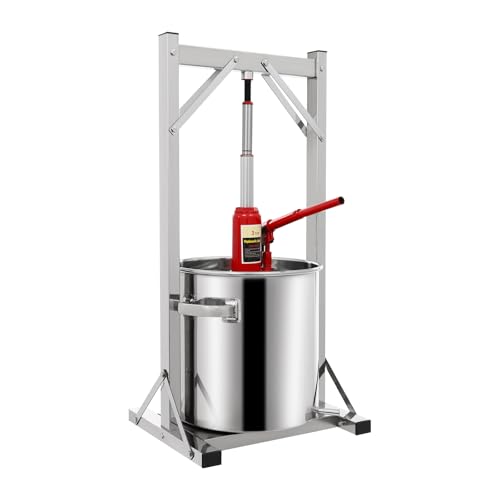
- 3-ton jack supplies up to 6,600 pounds
- 22L barrel with 11L filter basket
- 304 stainless steel and included filter cloth
Best For: Compact hydraulic pressing for home and small-scale use
Best Large-Batch Manual Press
4.75-Gallon Beechwood Cider Press

- 18L/4.75-gallon capacity
- Stable beechwood basket and base
- Includes two filter bags
Best For: Families, farms, and small wineries needing versatile manual pressing
Best High-Capacity Hydraulic Press
40L 5-Ton Stainless Steel Cider Press

- 40L/10.6-gallon capacity
- Hydraulic force up to five tons
- AISI 304 stainless juice-contact parts
Best For: Orchards and harvest-season users handling substantial batches
Best Stable Traditional Press
4.75-Gallon Heavy-Duty Beechwood Cider Press

- Heavy-duty stand with pour spout
- Breakaway beechwood basket
- Quiet, no-motor operation
Best For: Home cider makers and small seasonal juice or wine batches
High-Yield Hydraulic Pick
5.3-Gallon Stainless Hydraulic Press

- 5.3-gallon stainless basket for larger batches
- Water-powered hydraulic pressing reduces effort
- Includes filter bag and detachable basket
Best For: Home brewers seeking convenient medium-to-large batch pressing
Compact Jack-Press Choice

- 5.81-gallon outer bucket for larger pressing cycles
- 3-ton hydraulic jack reduces manual effort
- 304 stainless steel with reinforced support frame
Best For: Small wineries and home users needing capacity in a compact design
Largest-Batch Option
VEVOR 7.93-Gallon Hydraulic Press

- 7.93-gallon (30L) capacity for the biggest batches
- 3-ton jack and 4 mm pressing plate support strong pressure
- Includes two filter bags and removable bucket
Best For: Orchards, farms, and high-volume home pressing
High-Capacity Water-Powered Pick – Hydropress Cider Wine Fruit Press
For shoppers comparing cider presses for large batches, this Hydropress offers water-powered pressing with a listed 23.8-gallon product title and working capacities of 5.3 or 10.7 gallons. It uses up to 3 Bar of garden-hose pressure and is designed for apples, pears, berries, and other fruit.
Best For: Home fruit processors who want hose-powered pressing and flexible batch capacities.
Pros:
- Uses garden-hose water pressure up to 3 Bar.
- Offers 5.3- and 10.7-gallon capacity options.
- Includes a press bag and splash-water protection.
- Sheet metal gap is designed for better output.
Cons:
- At 79 pounds, it is relatively heavy to move.
- Requires access to a suitable garden-hose water supply.
The Hydropress is a practical choice when low-effort, water-assisted pressing matters more than portability. Its included accessories and fruit versatility make it well suited to seasonal cider and juice projects.
Heirloom-Style Workhorse – Homestader Apple Cider Press
For cider presses for large batches, the Homestader emphasizes durable construction and fast fruit pressing. Its hard maple and cast iron build is intended for long-term use while handling apples and other fruits for maximum juice extraction.
Best For: Families and serious home users seeking a durable, traditional-style cider press.
Pros:
- Combines hard maple and cast iron construction.
- Designed to last for generations.
- Presses apples and fruit quickly.
- Built around maximizing juice output.
Cons:
- The supplied notes do not specify its batch capacity.
- The durable construction may be less convenient to move than a lighter press.
The Homestader stands out for buyers who value longevity and traditional materials. Although capacity details are not provided, its fast-pressing design makes it a compelling option for recurring seasonal use.
High-Output Family Heirloom – American Harvester Double-Tub Press
Among cider presses for large batches, the American Harvester is built around a grinder-and-press workflow. Its double-tub design, Apple Eater grinder, and two-person operation are intended to process substantial quantities, with a stated output of up to 50 gallons in an afternoon.
Best For: Two-person teams processing large apple harvests for cider, juice, or wine.
Pros:
- Can produce up to 50 gallons in an afternoon with two operators.
- Apple Eater grinder reduces apples to a fine texture.
- Double-tub design combines grinding and squeezing.
- Uses hard maple and cast iron construction.
Cons:
- Requires two-person operation for the stated output.
- Its larger, heirloom-style design may require more setup space.
This is the strongest match here for coordinated, high-volume processing. The integrated grinder and double-tub layout can streamline harvest days, especially when two people can share the work.
Hydraulic Stainless-Steel Choice – 22L Hydraulic Fruit Press
For cider presses for large batches on a countertop, this 22L stainless-steel model uses a 3-ton hydraulic jack to apply up to 6,600 pounds of pressure. Its 11L perforated filter basket, included cloth, and 22L outer barrel are designed for apples, grapes, berries, and other extraction tasks.
Best For: Home brewers, craft cider makers, and small operations wanting hydraulic pressing in a compact footprint.
Pros:
- 3-ton hydraulic jack provides powerful, even pressing.
- 22L outer barrel and 11L filter basket separate pulp from juice.
- 304 stainless steel is rust-resistant and easy to clean.
- Includes a fine-mesh filter cloth and juice outlet.
Cons:
- The 22L capacity is smaller than some dedicated large-batch presses.
- Its hydraulic operation requires manual pumping.
This press offers a useful balance of force, cleanup, and footprint. It is particularly practical when you want hydraulic assistance and filtered juice without committing to a much larger traditional press.
Best Large-Batch Manual Press – 4.75-Gallon Beechwood Cider Press
For shoppers comparing cider presses for large batches, this 18-liter VEVOR model offers a substantial manual capacity for family gatherings, parties, wineries, and farms. Its beechwood basket, filter bags, and progressive screw mechanism are designed for efficient juice extraction, though hard fruit must be crushed before pressing.
Best For: Families, small farms, wineries, and other users who want a versatile 4.75-gallon manual press.
Pros:
- 18L/4.75-gallon capacity suits larger pressing sessions.
- Natural beechwood basket and triangular base provide a stable, food-focused setup.
- Includes two filter bags and eight supporting blocks for thorough extraction.
- Works with fruit, wine, pulp, cheese, and olive oil applications.
Cons:
- Hard fruits need to be crushed before pressing.
- Manual operation requires hand washing and physical effort.
- Its 30.9-pound, nearly 28-inch-tall design needs dedicated storage space.
This is a capable all-purpose option when you want larger capacity without a hydraulic system. Pairing it with a suitable crusher can make repeated apple or other hard-fruit batches more efficient.
Best High-Capacity Hydraulic Press – 40L 5-Ton Stainless Steel Cider Press
Among cider presses for large batches, this Mosakar model stands out for its 40-liter capacity and hydraulic jack, which applies up to five tons of pressure at a time. AISI 304 stainless steel juice-contact components and an adjustable juice tray make it well suited to harvest-season or orchard work.
Best For: Orchards, home harvests, parties, and users who prioritize high capacity and hydraulic pressing power.
Pros:
- Large 10.6-gallon/40L capacity handles substantial batches.
- Hydraulic jack delivers up to five tons of pressure.
- Stainless steel basket, pressing plate, and tray resist acidic juice and are easy to clean.
- Adjustable tray height and 90-degree-turning beam improve loading and container compatibility.
Cons:
- At 85 pounds, it is considerably less portable than smaller manual presses.
- Its 31.6-inch height and large footprint require adequate workspace.
- The supplied notes do not specify included filter bags or a crusher.
This is the strongest capacity-focused choice in the group. Its hydraulic mechanism and stainless juice-contact parts make it particularly practical for repeated, high-volume sessions, provided you have room for its heavy frame.
Best Stable Traditional Press – 4.75-Gallon Heavy-Duty Beechwood Cider Press
This 4.75-gallon fruit and wine press is a practical choice for cider presses for large batches when you prefer a traditional, quiet manual design. Its heavy-duty stand, built-in pour spout, and breakaway basket support straightforward loading, pressing, and pulp removal for apples, pears, grapes, and berries.
Best For: Home users and small juice or wine operations seeking a stable, no-motor press for seasonal batches.
Pros:
- 4.75-gallon capacity offers useful batch size for home pressing.
- Heavy-duty stand includes a pour spout and optional foot mounting points.
- Solid red beech basket is designed to resist moisture and wear.
- Breakaway basket allows faster pulp removal between pressing cycles.
Cons:
- Manual pressing requires physical effort and repeated handle turning.
- Fruit must be crushed before loading for the described operation.
- Hand-wash care and a roughly 27.6-inch height may not suit every setup.
Choose this model for a stable, uncomplicated workflow rather than maximum throughput. The pour spout and removable basket are useful details for home cider makers who value easy collection and cleanup between batches.
High-Yield Hydraulic Pick – 5.3-Gallon Stainless Hydraulic Press
For shoppers comparing cider presses for large batches, this 5.3-gallon hydraulic model offers a practical balance of capacity, juice yield, and cleanup convenience. Its hose-powered pressing system is designed to reduce manual effort when processing apples, grapes, berries, and other ingredients.
Best For: Home brewers and cider makers who want a food-grade stainless press for repeated medium-to-large batches.
Pros:
- 5.3-gallon (20L) basket supports larger single-batch pressing.
- Hydraulic system uses standard household water pressure to do the pressing work.
- Stainless basket, filter bag, and detachable design support cleaner juice and easier cleanup.
- Versatile enough for fruit, herbs, nut milks, and honey.
Cons:
- Requires access to a garden hose and household water supply.
- At 28 pounds, it is substantial to move and store.
- Its 5.3-gallon capacity is smaller than some larger 30L options.
The combination of hydraulic operation, a sturdy coated-steel frame, and a filter bag makes this a convenient choice when reducing effort and pulp in home cider production are priorities.
Compact Jack-Press Choice – 5.8-Gallon 3-Ton Fruit Press
This 5.8-gallon stainless steel model is a strong contender among cider presses for large batches, pairing a manual hydraulic jack with a reinforced frame. It is designed to handle fruit, grapes, apples, cheese ingredients, and wine-making tasks while keeping its freestanding footprint relatively compact.
Best For: Home kitchens, small wineries, farms, and beverage-preparation areas needing substantial capacity in a compact press.
Pros:
- 5.81-gallon outer bucket accommodates larger pressing cycles.
- 3-ton hydraulic jack provides stable pressing force with less effort than traditional manual pressing.
- Food-contact 304 stainless steel resists corrosion and is designed for convenient cleaning.
- Reinforced triangular supports help stabilize the press during operation.
Cons:
- Hand-wash care may require more cleanup time.
- The included filter bucket is smaller at 2.91 gallons than the outer bucket.
- The manual jack requires physical operation for each press.
With a polished stainless construction, 3-ton jack, and space-saving freestanding design, this press suits users who want higher capacity without committing to a larger commercial-style setup.
Largest-Batch Option – VEVOR 7.93-Gallon Hydraulic Press
If your priority is maximum capacity among these cider presses for large batches, this VEVOR model holds 7.93 gallons, or 30 liters. Its jack-style design, thickened pressing plate, and included filter bags are built for processing substantial amounts of apples, grapes, vegetables, and other mash at once.
Best For: Orchards, farms, wineries, and serious home users who regularly press larger quantities of fruit or other ingredients.
Pros:
- 7.93-gallon (30L) capacity is the largest in this comparison.
- Jack-style press supports up to 3 tons or 6,614 pounds of load.
- Thickened 4 mm pressing plate is designed for stronger, more efficient pressing.
- Includes two filter bags and a removable bucket for easier cleanup.
Cons:
- At 57.8 pounds, it is considerably heavier than the other listed models.
- Its larger dimensions require more storage space.
- Fruit should be cut first for better pressing results.
This is the most suitable pick when batch size matters most. The larger 30L capacity and heavy-duty pressing hardware can reduce the number of cycles needed during a busy harvest or production session.
How We Picked the Best Cider Presses for Large Batches
We focused on the factors that matter when pressing repeated loads of apples, grapes, berries, or other fruit: basket capacity, pressing mechanism, frame stability, juice-contact materials, cleanup, and practical throughput. The selection includes hydraulic and manual designs, stainless steel and wood baskets, and models ranging from roughly 4.75 gallons to nearly 24 gallons.
Capacity alone does not determine performance. A larger basket can reduce loading and unloading, while a hydraulic jack may make pressing dense pomace less physically demanding. We also considered whether each design suits home cider makers, small orchards, or users who need a more production-oriented workflow.
Quick Comparison
| Type | Best for | Main advantage | Potential trade-off |
|---|---|---|---|
| Hydraulic press | Frequent or demanding batches | High, consistent pressure with less manual effort | Heavier, more complex, and often costlier |
| Manual basket press | Occasional home pressing | Simple operation and maintenance | Slower and more labor-intensive |
| Double-tub press | Continuous workflow | One tub can be loaded while another is pressed | Larger footprint and more assembly |
| Stainless steel press | Hygiene-focused users | Durable, nonporous juice-contact surfaces | Can weigh more than wood models |
Key Buying Factors for Cider Presses for Large Batches
Capacity and Batch Workflow
Choose a basket size based on the amount of prepared fruit you expect to process at one time. Larger 10.6- to 23.8-gallon models can reduce the number of cycles, but they also require more storage space and enough crushed fruit to fill the basket efficiently.
Pressure and Operating Effort
Hydraulic jacks are useful for large batches because they apply strong, repeatable pressure without requiring constant hand-cranking. Manual presses can still work well for smaller harvests, especially when simplicity and portability matter.
Construction and Sanitation
Look for rigid frames, stable feet, and a collection area that directs juice cleanly into a suitable container. Stainless steel is easy to sanitize and resists staining; wood baskets can be effective but need careful washing and thorough drying after every use.
Yield, Drainage, and Cleanup
A filter bag, drainage channels, splash guard, or perforated inner basket can improve workflow and reduce mess. Confirm that removable parts are accessible for washing and that the press can be dried completely before storage.
Who Should Buy Which Cider Presses for Large Batches?
Choose a large hydraulic model if you process substantial harvests, want less physical effort, or need repeatable pressure across many loads. These are among the most practical Cider Presses for Large Batches.
Choose a double-tub system if speed and continuous work are more important than a small footprint. It is particularly useful when one person prepares fruit while another operates the press.
Choose a 4.75- to 5.8-gallon manual or hydraulic press for occasional home cider making, limited storage, or smaller harvests. These models offer a manageable balance of capacity and portability.
Choose stainless steel juice-contact components if hygiene, durability, and easy sanitation are top priorities. Regardless of the design, verify the press dimensions, jack rating, basket capacity, and included accessories before buying.