Making smooth tomato sauce at home does not require a restaurant-sized appliance. The best tomato presses for small kitchens remove skins and seeds efficiently while keeping storage, cleanup, and counter space manageable.
This roundup compares 10 manual and electric options, including compact food mills, clamp-based strainers, and higher-capacity machines for cooks who preserve larger batches.
Best 10 Tomato Presses for Small Kitchens Picks for 2026
Best Clamp-On Pick

- Clamp fits countertops 3/4–2-1/8 inches thick
- Includes 1.3mm tomato screen
- Manual operation with optional motor upgrade
Best For: Compact kitchens needing a secure, versatile countertop strainer
Best Multi-Use Strainer
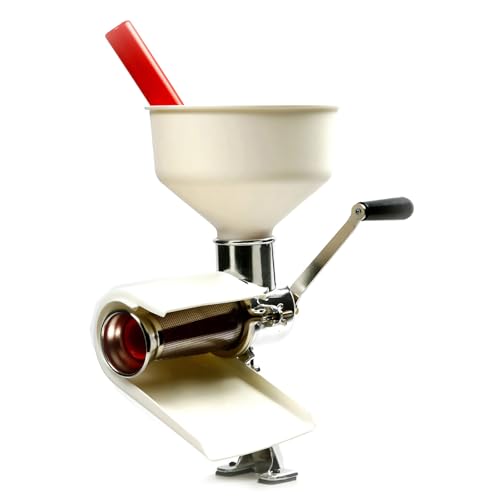
- Three-quart listed capacity
- Separates juice and pulp in one operation
- Includes fine screen and standard spiral
Best For: Hand-crank sauce and puree preparation across multiple ingredients
Best Electric Powerhouse

- Automatic skin-and-seed separation
- Rated for up to 330 pounds per hour
- 220-volt corded electric operation
Best For: High-volume tomato processing with minimal hand cranking
Best Disc Variety
Hungry Artisan 3-Disc Food Mill

- Three discs provide coarse to fine textures
- No outlet required
- Stainless steel construction and crank
Best For: Small-batch sauces with adjustable texture and portable setup
Best Mounted Option
Weston Stainless Steel Tomato Strainer
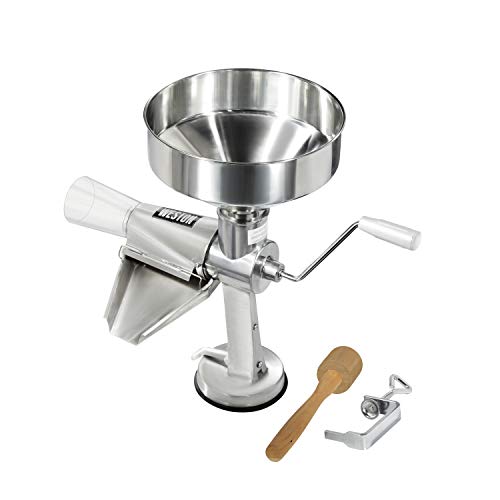
- One-gallon hopper for larger batches
- Dual suction-cup and C-clamp mounting
- Includes stomper and 1.5mm screen
Best For: Manual batch processing with flexible countertop or table mounting
Best Electric Pick
VEVOR 370W Electric Tomato Strainer

- 370W motor reduces manual effort
- Separates skins and seeds in one pass
- Tool-free disassembly for cleaning
Best For: Fast, frequent, and higher-volume sauce processing
Best Compact Manual Mill
Stainless Steel Rotary Food Mill

- Three discs for adjustable textures
- Works with sauces, purees, and potatoes
- Dishwasher-safe and easy to store
Best For: Small-batch cooking and multipurpose soft-food preparation
Compact Manual Pick

- Stainless steel filter separates skins and seeds
- Manual, energy-saving operation
- Machine-washable design with large feed inlet
Best For: Small kitchens needing a simple manual press
Multiuse Kitchen Choice

- Three discs support different textures
- Stable dual-hook design with nonslip crank
- Dishwasher-safe and includes useful accessories
Best For: Cooks wanting one manual mill for varied foods
High-Volume Electric Option

- 250-watt motor with forward and reverse speeds
- One-gallon hopper for larger batches
- Three screens for varied textures
Best For: Batch processing and preserving with available storage space
Best Clamp-On Pick – Johnny Apple Sauce Maker
For small kitchens, the Johnny Apple Sauce Maker is a practical tomato press for small kitchens because its clamp mount secures to countertops from 3/4 to 2-1/8 inches thick. Its hand-crank design separates skins and seeds while keeping the setup relatively compact for countertop use.
Best For: Home cooks who want a clamp-mounted press for tomato sauce, purees, jams, and other produce.
Pros:
- Includes a 1.3mm apple/tomato screen and standard spiral.
- Clamp provides 10 square inches of countertop contact.
- Can be used manually or fitted with an optional electric motor.
- Cast aluminum body and stainless steel screens come with a stated five-year warranty.
Cons:
- The optional motor is sold separately.
- Additional salsa, pumpkin, and berry screens cost extra.
- Hand-cranking requires more effort than an electric model.
This is a flexible choice when secure mounting and multi-purpose use matter more than fully automatic operation. Its included tomato screen lets you start making smooth sauces without buying extra accessories.
Best Multi-Use Strainer – Norpro 1951 Sauce Master
The Norpro 1951 Sauce Master is a useful tomato press for small kitchens when you want one hand-operated tool for vegetables, fruit, and purees. It forces food through a chrome-plated steel screen while separating juice and pulp in one operation.
Best For: Cooks making tomato sauce, fruit purees, and other small-batch preparations with a hand-crank strainer.
Pros:
- Handles vegetables, fruits, and purees.
- Includes a fine mesh screen, standard spiral, and recipe booklet.
- Has a listed three-quart capacity.
- Additional berry, pumpkin, and salsa screens are available.
Cons:
- Additional screens are sold separately.
- Hand wash only.
- The listed dimensions are comparatively large for a small-kitchen appliance.
The Sauce Master makes sense for cooks who value versatility and a generous three-quart capacity. Check your available storage and counter space before choosing it for a particularly compact kitchen.
Best Electric Powerhouse – OMRA Spremy Model 850
The OMRA Spremy Model 850 brings electric operation to tomato presses for small kitchens, automatically separating puree from skins and seeds. Its compact listed footprint is appealing, although its high hourly capacity is better suited to larger tomato-processing jobs than occasional sauce making.
Best For: Users who want automatic tomato processing and expect to handle substantial quantities.
Pros:
- Electric motor automates puree extraction.
- Processes fresh or cooked tomatoes.
- Listed production reaches up to 330 pounds per hour.
- Uses a stainless steel hopper and die-cast metal housing.
Cons:
- Requires a corded electrical connection.
- Specifications list 220-volt operation, which may not suit every kitchen.
- Its very high capacity may be unnecessary for small batches.
This is the strongest option for speed and volume, not necessarily simplicity. Confirm that your kitchen supports the listed 220-volt requirement before considering it.
Best Disc Variety – Hungry Artisan 3-Disc Food Mill
The Hungry Artisan 3-Disc Food Mill is a straightforward tomato press for small kitchens that does not require an outlet. Its three stainless steel discs let you adjust the texture of tomato sauce, while the compact, low-profile design is easy to position for hand-crank use.
Best For: Cooks who want adjustable sauce textures and a portable manual tool for canning and everyday food preparation.
Pros:
- Includes coarse, medium, and fine stainless steel discs.
- Works without an electrical outlet.
- Stainless steel body, discs, and crank are designed for repeated use.
- Also handles applesauce, mashed potatoes, baby food, purees, and jam bases.
Cons:
- Manual cranking takes more effort than an electric press.
- It does not specifically list a clamp mount.
- Its disc-based design may require choosing and changing discs for different textures.
This food mill is a good fit when flexibility and outlet-free operation are priorities. The three-disc system is especially useful if your recipes range from chunky preparations to smooth tomato sauce.
Best Mounted Option – Weston Stainless Steel Tomato Strainer
For shoppers comparing tomato presses for small kitchens, the Weston Tomato Strainer offers a sturdy manual setup with flexible mounting. Its one-gallon hopper handles substantial batches, while the stainless steel screen separates skins and seeds without requiring peeling or coring first.
Best For: Home cooks who want a manually operated press that can mount securely to a countertop or table.
Pros:
- Dual suction-cup and C-clamp mounting system works on various flat surfaces.
- One-gallon hopper supports larger batches without constant refilling.
- Includes a stomper and 1.5mm multipurpose screen for tomatoes and apples.
- Splash guard and directed chute help make processing cleaner.
Cons:
- Manual cranking requires more effort than an electric strainer.
- Additional screens are sold separately.
- The larger hopper may be more capacity than needed for very small portions.
This is a practical choice when mounting flexibility and stainless steel construction matter more than compact, handheld storage. It is especially useful for cooks processing sauces, salsa, jams, or purees in larger batches.
Best Electric Pick – VEVOR 370W Electric Tomato Strainer
Among tomato presses for small kitchens, the VEVOR Electric Tomato Strainer is the effort-saving choice. Its 370W motor processes tomatoes into sauce, puree, or juice in a single pass, and the large hopper is designed to reduce repeated refilling during high-volume preparation.
Best For: Cooks who want faster, lower-effort processing for frequent sauce making or harvest-season batches.
Pros:
- 370W motor reduces manual cranking effort.
- Stainless steel filter screen separates peels and seeds in one pass.
- Large hopper improves efficiency for bigger batches.
- Core components disassemble without tools for quicker cleaning.
Cons:
- It is designed for high-volume processing, which may be more machine than occasional users need.
- Tomatoes should be cut into small pieces to help reduce clogging.
- Motorized operation requires access to a suitable power source.
The VEVOR stands out when speed and reduced physical effort are priorities. Its stainless steel components and tool-free disassembly also support repeated sauce making, though its batch-focused design may not be the most space-conscious fit for minimal prep.
Best Compact Manual Mill – Stainless Steel Rotary Food Mill
For small kitchens that need flexibility beyond tomato sauce, this stainless steel rotary food mill is a versatile alternative among tomato presses for small kitchens. Three interchangeable discs let you choose a coarse, medium, or fine texture, while the hand crank handles cooked soft foods, fruits, vegetables, and potatoes.
Best For: Everyday cooking, small-batch purees, and cooks who want one manual tool for multiple soft-food preparations.
Pros:
- Three interchangeable discs provide coarse, medium, and fine textures.
- Handles tomato sauce, applesauce, mashed potatoes, soups, and purees.
- Dishwasher-safe stainless steel is resistant to stains and corrosion.
- Compact design and hanging hole support easier storage.
Cons:
- Manual cranking is less convenient for large batches than an electric strainer.
- It is intended for soft or cooked foods rather than whole hard produce.
- Changing discs adds an extra setup step when switching textures.
This food mill is a sensible space-conscious pick when versatility and storage matter. Its adjustable discs make it more adaptable than a single-purpose tomato press, while the manual design suits everyday portions and seasonal food preparation.
Compact Manual Pick – Adjustable Tomato Press
For shoppers comparing tomato presses for small kitchens, this manual tomato juicer offers a straightforward way to separate tomato skins and seeds from pulp without relying on a motor. Its simple design, adjustable feature, and dishwasher-safe care instructions make it practical for routine sauce preparation.
Best For: Small kitchens that need a manual press for sauces, juices, and soft fruits or vegetables.
Pros:
- Stainless steel filter separates skins and seeds from pulp.
- Manual operation saves electricity and has a simple structure.
- Large feed inlet can hold more produce at once.
- Listed as machine washable for easier cleanup.
Cons:
- Manual operation requires hands-on effort.
- Its approximately 9.84-by-9.06-by-7.09-inch footprint may still require dedicated storage.
This is a sensible space-conscious option when you value simple operation and easy cleaning over the speed of an electric machine.
Multiuse Kitchen Choice – Stainless Steel Food Mill
This stainless steel food mill is a versatile alternative for anyone searching for tomato presses for small kitchens. Three milling discs let you adjust the texture of tomato sauce, while the dual-hook design helps stabilize the mill over a bowl during use.
Best For: Cooks who want one compact manual tool for tomato sauce, mashed potatoes, jams, fruits, and vegetables.
Pros:
- Includes three milling discs for different textures and ingredients.
- Stainless steel construction is sturdy and dishwasher-safe.
- Dual hooks and a nonslip crank help secure the mill over a bowl.
- Includes a multifunctional spoon, funnel, and measuring spoon.
Cons:
- Manual cranking is less convenient for large batches.
- Its broader purpose may be more than needed if you only strain tomatoes.
Choose this model if flexibility matters: it can handle tomato sauce while also serving as a general-purpose food mill for other kitchen tasks.
High-Volume Electric Option – Weston Deluxe Tomato Strainer
Among tomato presses for small kitchens, the Weston Deluxe is the power-focused choice. Its 250-watt motor, two speeds, one-gallon hopper, and three stainless steel screens are designed to process tomatoes and other soft produce efficiently for sauces, purees, jams, salsa, and preserving.
Best For: Home cooks processing garden harvests or larger batches who have room for a 14-by-12-by-17-inch appliance.
Pros:
- 250-watt motor includes forward and reverse speeds to help prevent jamming.
- One-gallon hopper supports larger batches.
- Three screens offer fine, medium, and chunkier processing options.
- Separates skins and seeds without coring tomatoes.
Cons:
- The electric design and 17-inch height require more counter or storage space.
- Less compact than a manual food mill for occasional small batches.
- Requires access to a 120-volt outlet.
This model makes the most sense when speed and batch capacity outweigh the storage demands of a larger electric strainer.
How We Picked the Best Tomato Presses for Small Kitchens
We focused on the practical needs of home cooks: footprint, operating method, hopper and batch capacity, construction, cleaning effort, and versatility. The selection includes manual presses and food mills for occasional sauce making, plus electric models for gardeners and home canners processing larger harvests. We also considered whether each design separates skins and seeds effectively and whether it can handle related tasks such as applesauce, jams, or cooked vegetables.
Because product specifications and included accessories can vary, check the current listing for dimensions, disc styles, motor details, and replacement parts before ordering.
Quick Comparison
| Type | Best for | Main advantage | Trade-off |
|---|---|---|---|
| Clamp-based manual strainer | Small batches and limited storage | Compact, simple operation | Requires hand cranking |
| Rotary food mill | Sauce, purées, and baby food | Versatile with interchangeable discs | May leave more texture than a dedicated press |
| Manual hopper press | Regular home sauce making | No electricity and greater throughput | Needs counter or table space |
| Electric tomato strainer | Large harvests and frequent canning | Faster processing with less manual effort | Larger, louder, and more expensive |
Key Buying Factors for Tomato Presses for Small Kitchens
Size and Storage
Measure both your available counter space and cabinet height. A clamp model or handheld food mill is easier to store, while electric units often need a permanent shelf or a dedicated setup area.
Manual Versus Electric Operation
Manual presses are quiet, affordable, and easy to use away from an outlet. They are usually the better fit for occasional batches. Electric models reduce cranking and can process substantially more produce, but they add motor noise, cord management, and cleanup around electrical components.
Capacity and Output
For a few servings of fresh sauce, a small hopper is sufficient. If you process garden tomatoes or can sauce by the batch, look for a larger hopper and a stated hourly capacity. Do not choose solely by advertised throughput; tomato softness, preparation, and feeding technique affect real-world results.
Materials, Discs, and Cleanup
Stainless steel components resist staining and are useful for frequent food preparation. Multiple discs or screens provide more control over texture and expand a food mill’s uses. Removable parts and dishwasher-safe components can make a bigger difference than extra capacity in a small kitchen.
Who Should Buy Which Tomato Presses for Small Kitchens?
Choose a compact clamp-based strainer if storage is your top concern and you make sauce only occasionally. Select a stainless steel rotary food mill if you want one tool for tomato sauce, mashed foods, jams, and purées. A larger manual hopper model suits cooks who want higher capacity without adding a motor. For gardeners, home canners, or anyone processing many pounds of tomatoes, an electric strainer is usually worth considering despite its larger footprint.
Before buying, confirm that the press fits your bowls or pots, the screen matches your preferred sauce texture, and replacement screens or augers are available. The right choice is the smallest machine that comfortably handles your normal batch size.